A social media surgery is a gathering at which volunteer "surgeons" with expertise in using web tools, chiefly social media, offer free advice in using such tools, to representatives ("patients") of non-profit organisations, charities, community groups and activists, with "no boring speeches or jargon". The idea was conceived by Pete Ashton, with Nick Booth of Podnosh Ltd, who ran the first such surgery in Birmingham, England, on 15 October 2008. In July 2009, a spin-off surgery (dubbed the "Social media mob") started in Mosman, Australia, and in January 2010, the first spin-off surgery in Africa was held. On 16 February 2012, it was announced that the Social Media Surgery movement had won "the Prime Minister’s Big Society Award". Prime Minister David Cameron said: This is an excellent initiative - such a simple idea and yet so effective. The popularity of these surgeries and the fact that they have inspired so many others across the country to follow in their footsteps, is testament to its brilliance. Congratulations to Nick and all the volunteers who have shared their time and expertise to help so many local groups make the most of the internet to support their community. A great example of the Big Society in action. The scheme also won the 2013 Adult Learners' Week "BBC Learning Through Technology Award".
Actor-critic algorithm
The actor-critic algorithm (AC) is a family of reinforcement learning (RL) algorithms that combine policy-based RL algorithms such as policy gradient methods, and value-based RL algorithms such as value iteration, Q-learning, SARSA, and TD learning. An AC algorithm consists of two main components: an "actor" that determines which actions to take according to a policy function, and a "critic" that evaluates those actions according to a value function. Some AC algorithms are on-policy, some are off-policy. Some apply to either continuous or discrete action spaces. Some work in both cases. == Overview == The actor-critic methods can be understood as an improvement over pure policy gradient methods like REINFORCE via introducing a baseline. === Actor === The actor uses a policy function π ( a | s ) {\displaystyle \pi (a|s)} , while the critic estimates either the value function V ( s ) {\displaystyle V(s)} , the action-value Q-function Q ( s , a ) , {\displaystyle Q(s,a),} the advantage function A ( s , a ) {\displaystyle A(s,a)} , or any combination thereof. The actor is a parameterized function π θ {\displaystyle \pi _{\theta }} , where θ {\displaystyle \theta } are the parameters of the actor. The actor takes as argument the state of the environment s {\displaystyle s} and produces a probability distribution π θ ( ⋅ | s ) {\displaystyle \pi _{\theta }(\cdot |s)} . If the action space is discrete, then ∑ a π θ ( a | s ) = 1 {\displaystyle \sum _{a}\pi _{\theta }(a|s)=1} . If the action space is continuous, then ∫ a π θ ( a | s ) d a = 1 {\displaystyle \int _{a}\pi _{\theta }(a|s)da=1} . The goal of policy optimization is to improve the actor. That is, to find some θ {\displaystyle \theta } that maximizes the expected episodic reward J ( θ ) {\displaystyle J(\theta )} : J ( θ ) = E π θ [ ∑ t = 0 T γ t r t ] {\displaystyle J(\theta )=\mathbb {E} _{\pi _{\theta }}\left[\sum _{t=0}^{T}\gamma ^{t}r_{t}\right]} where γ {\displaystyle \gamma } is the discount factor, r t {\displaystyle r_{t}} is the reward at step t {\displaystyle t} , and T {\displaystyle T} is the time-horizon (which can be infinite). The goal of policy gradient method is to optimize J ( θ ) {\displaystyle J(\theta )} by gradient ascent on the policy gradient ∇ J ( θ ) {\displaystyle \nabla J(\theta )} . As detailed on the policy gradient method page, there are many unbiased estimators of the policy gradient: ∇ θ J ( θ ) = E π θ [ ∑ 0 ≤ j ≤ T ∇ θ ln π θ ( A j | S j ) ⋅ Ψ j | S 0 = s 0 ] {\displaystyle \nabla _{\theta }J(\theta )=\mathbb {E} _{\pi _{\theta }}\left[\sum _{0\leq j\leq T}\nabla _{\theta }\ln \pi _{\theta }(A_{j}|S_{j})\cdot \Psi _{j}{\Big |}S_{0}=s_{0}\right]} where Ψ j {\textstyle \Psi _{j}} is a linear sum of the following: ∑ 0 ≤ i ≤ T ( γ i R i ) {\textstyle \sum _{0\leq i\leq T}(\gamma ^{i}R_{i})} . γ j ∑ j ≤ i ≤ T ( γ i − j R i ) {\textstyle \gamma ^{j}\sum _{j\leq i\leq T}(\gamma ^{i-j}R_{i})} : the REINFORCE algorithm. γ j ∑ j ≤ i ≤ T ( γ i − j R i ) − b ( S j ) {\textstyle \gamma ^{j}\sum _{j\leq i\leq T}(\gamma ^{i-j}R_{i})-b(S_{j})} : the REINFORCE with baseline algorithm. Here b {\displaystyle b} is an arbitrary function. γ j ( R j + γ V π θ ( S j + 1 ) − V π θ ( S j ) ) {\textstyle \gamma ^{j}\left(R_{j}+\gamma V^{\pi _{\theta }}(S_{j+1})-V^{\pi _{\theta }}(S_{j})\right)} : TD(1) learning. γ j Q π θ ( S j , A j ) {\textstyle \gamma ^{j}Q^{\pi _{\theta }}(S_{j},A_{j})} . γ j A π θ ( S j , A j ) {\textstyle \gamma ^{j}A^{\pi _{\theta }}(S_{j},A_{j})} : Advantage Actor-Critic (A2C). γ j ( R j + γ R j + 1 + γ 2 V π θ ( S j + 2 ) − V π θ ( S j ) ) {\textstyle \gamma ^{j}\left(R_{j}+\gamma R_{j+1}+\gamma ^{2}V^{\pi _{\theta }}(S_{j+2})-V^{\pi _{\theta }}(S_{j})\right)} : TD(2) learning. γ j ( ∑ k = 0 n − 1 γ k R j + k + γ n V π θ ( S j + n ) − V π θ ( S j ) ) {\textstyle \gamma ^{j}\left(\sum _{k=0}^{n-1}\gamma ^{k}R_{j+k}+\gamma ^{n}V^{\pi _{\theta }}(S_{j+n})-V^{\pi _{\theta }}(S_{j})\right)} : TD(n) learning. γ j ∑ n = 1 ∞ λ n − 1 1 − λ ⋅ ( ∑ k = 0 n − 1 γ k R j + k + γ n V π θ ( S j + n ) − V π θ ( S j ) ) {\textstyle \gamma ^{j}\sum _{n=1}^{\infty }{\frac {\lambda ^{n-1}}{1-\lambda }}\cdot \left(\sum _{k=0}^{n-1}\gamma ^{k}R_{j+k}+\gamma ^{n}V^{\pi _{\theta }}(S_{j+n})-V^{\pi _{\theta }}(S_{j})\right)} : TD(λ) learning, also known as GAE (generalized advantage estimate). This is obtained by an exponentially decaying sum of the TD(n) learning terms. === Critic === In the unbiased estimators given above, certain functions such as V π θ , Q π θ , A π θ {\displaystyle V^{\pi _{\theta }},Q^{\pi _{\theta }},A^{\pi _{\theta }}} appear. These are approximated by the critic. Since these functions all depend on the actor, the critic must learn alongside the actor. The critic is learned by value-based RL algorithms. For example, if the critic is estimating the state-value function V π θ ( s ) {\displaystyle V^{\pi _{\theta }}(s)} , then it can be learned by any value function approximation method. Let the critic be a function approximator V ϕ ( s ) {\displaystyle V_{\phi }(s)} with parameters ϕ {\displaystyle \phi } . The simplest example is TD(1) learning, which trains the critic to minimize the TD(1) error: δ i = R i + γ V ϕ ( S i + 1 ) − V ϕ ( S i ) {\displaystyle \delta _{i}=R_{i}+\gamma V_{\phi }(S_{i+1})-V_{\phi }(S_{i})} The critic parameters are updated by gradient descent on the squared TD error: ϕ ← ϕ − α ∇ ϕ ( δ i ) 2 = ϕ + α δ i ∇ ϕ V ϕ ( S i ) {\displaystyle \phi \leftarrow \phi -\alpha \nabla _{\phi }(\delta _{i})^{2}=\phi +\alpha \delta _{i}\nabla _{\phi }V_{\phi }(S_{i})} where α {\displaystyle \alpha } is the learning rate. Note that the gradient is taken with respect to the ϕ {\displaystyle \phi } in V ϕ ( S i ) {\displaystyle V_{\phi }(S_{i})} only, since the ϕ {\displaystyle \phi } in γ V ϕ ( S i + 1 ) {\displaystyle \gamma V_{\phi }(S_{i+1})} constitutes a moving target, and the gradient is not taken with respect to that. This is a common source of error in implementations that use automatic differentiation, and requires "stopping the gradient" at that point. Similarly, if the critic is estimating the action-value function Q π θ {\displaystyle Q^{\pi _{\theta }}} , then it can be learned by Q-learning or SARSA. In SARSA, the critic maintains an estimate of the Q-function, parameterized by ϕ {\displaystyle \phi } , denoted as Q ϕ ( s , a ) {\displaystyle Q_{\phi }(s,a)} . The temporal difference error is then calculated as δ i = R i + γ Q θ ( S i + 1 , A i + 1 ) − Q θ ( S i , A i ) {\displaystyle \delta _{i}=R_{i}+\gamma Q_{\theta }(S_{i+1},A_{i+1})-Q_{\theta }(S_{i},A_{i})} . The critic is then updated by θ ← θ + α δ i ∇ θ Q θ ( S i , A i ) {\displaystyle \theta \leftarrow \theta +\alpha \delta _{i}\nabla _{\theta }Q_{\theta }(S_{i},A_{i})} The advantage critic can be trained by training both a Q-function Q ϕ ( s , a ) {\displaystyle Q_{\phi }(s,a)} and a state-value function V ϕ ( s ) {\displaystyle V_{\phi }(s)} , then let A ϕ ( s , a ) = Q ϕ ( s , a ) − V ϕ ( s ) {\displaystyle A_{\phi }(s,a)=Q_{\phi }(s,a)-V_{\phi }(s)} . Although, it is more common to train just a state-value function V ϕ ( s ) {\displaystyle V_{\phi }(s)} , then estimate the advantage by A ϕ ( S i , A i ) ≈ ∑ j ∈ 0 : n − 1 γ j R i + j + γ n V ϕ ( S i + n ) − V ϕ ( S i ) {\displaystyle A_{\phi }(S_{i},A_{i})\approx \sum _{j\in 0:n-1}\gamma ^{j}R_{i+j}+\gamma ^{n}V_{\phi }(S_{i+n})-V_{\phi }(S_{i})} Here, n {\displaystyle n} is a positive integer. The higher n {\displaystyle n} is, the more lower is the bias in the advantage estimation, but at the price of higher variance. The Generalized Advantage Estimation (GAE) introduces a hyperparameter λ {\displaystyle \lambda } that smoothly interpolates between Monte Carlo returns ( λ = 1 {\displaystyle \lambda =1} , high variance, no bias) and 1-step TD learning ( λ = 0 {\displaystyle \lambda =0} , low variance, high bias). This hyperparameter can be adjusted to pick the optimal bias-variance trade-off in advantage estimation. It uses an exponentially decaying average of n-step returns with λ {\displaystyle \lambda } being the decay strength. == Variants == Asynchronous Advantage Actor-Critic (A3C): Parallel and asynchronous version of A2C. Soft Actor-Critic (SAC): Incorporates entropy maximization for improved exploration. Deep Deterministic Policy Gradient (DDPG): Specialized for continuous action spaces.
Feature (machine learning)
In machine learning and pattern recognition, a feature is an individual measurable property or characteristic of a data set. Choosing informative, discriminating, and independent features is crucial to producing effective algorithms for pattern recognition, classification, and regression tasks. Features are usually numeric, but other types such as strings and graphs are used in syntactic pattern recognition, after some pre-processing step such as one-hot encoding. The concept of "features" is related to that of explanatory variables used in statistical techniques such as linear regression. == Feature types == In feature engineering, two types of features are commonly used: numerical and categorical. Numerical features are continuous values that can be measured on a scale. Examples of numerical features include age, height, weight, and income. Numerical features can be used in machine learning algorithms directly. Categorical features are discrete values that can be grouped into categories. Examples of categorical features include gender, color, and zip code. Categorical features typically need to be converted to numerical features before they can be used in machine learning algorithms. This can be done using a variety of techniques, such as one-hot encoding, label encoding, and ordinal encoding. The type of feature that is used in feature engineering depends on the specific machine learning algorithm that is being used. Some machine learning algorithms, such as decision trees, can handle both numerical and categorical features. Other machine learning algorithms, such as linear regression, can only handle numerical features. == Classification == A numeric feature can be conveniently described by a feature vector. One way to achieve binary classification is using a linear predictor function (related to the perceptron) with a feature vector as input. The method consists of calculating the scalar product between the feature vector and a vector of weights, qualifying those observations whose result exceeds a threshold. Algorithms for classification from a feature vector include nearest neighbor classification, neural networks, and statistical techniques such as Bayesian approaches. == Examples == In character recognition, features may include histograms counting the number of black pixels along horizontal and vertical directions, number of internal holes, stroke detection and many others. In speech recognition, features for recognizing phonemes can include noise ratios, length of sounds, relative power, filter matches, logarithmic Mel-scale spectral vectors and Mel-frequency cepstral coefficients, which represent the frequency characteristics of audio signals. In spam detection algorithms, features may include the presence or absence of certain email headers, the email structure, the language, the frequency of specific terms, the grammatical correctness of the text. In computer vision, there are a large number of possible features, such as edges and objects. == Feature vectors == In pattern recognition and machine learning, a feature vector is an n-dimensional vector of numerical features that represent some object. Many algorithms in machine learning require a numerical representation of objects, since such representations facilitate processing and statistical analysis. When representing images, the feature values might correspond to the pixels of an image, while when representing texts the features might be the frequencies of occurrence of textual terms. Feature vectors are equivalent to the vectors of explanatory variables used in statistical procedures such as linear regression. Feature vectors are often combined with weights using a dot product in order to construct a linear predictor function that is used to determine a score for making a prediction. The vector space associated with these vectors is often called the feature space. In order to reduce the dimensionality of the feature space, a number of dimensionality reduction techniques can be employed. Higher-level features can be obtained from already available features and added to the feature vector; for example, for the study of diseases the feature 'Age' is useful and is defined as Age = 'Year of death' minus 'Year of birth' . This process is referred to as feature construction. Feature construction is the application of a set of constructive operators to a set of existing features resulting in construction of new features. Examples of such constructive operators include checking for the equality conditions {=, ≠}, the arithmetic operators {+,−,×, /}, the array operators {max(S), min(S), average(S)} as well as other more sophisticated operators, for example count(S, C) that counts the number of features in the feature vector S satisfying some condition C or, for example, distances to other recognition classes generalized by some accepting device. Feature construction has long been considered a powerful tool for increasing both accuracy and understanding of structure, particularly in high-dimensional problems. Applications include studies of disease and emotion recognition from speech. == Selection and extraction == The initial set of raw features can be redundant and large enough that estimation and optimization is made difficult or ineffective. Therefore, a preliminary step in many applications of machine learning and pattern recognition consists of selecting a subset of features, or constructing a new and reduced set of features to facilitate learning, and to improve generalization and interpretability. Extracting or selecting features is a combination of art and science; developing systems to do so is known as feature engineering. It requires the experimentation of multiple possibilities and the combination of automated techniques with the intuition and knowledge of the domain expert. Automating this process is feature learning, where a machine not only uses features for learning, but learns the features itself.
Leakage (machine learning)
In statistics and machine learning, leakage (also known as data leakage or target leakage) refers to the use of information during model training that would not be available at prediction time. This results in overly optimistic performance estimates, as the model appears to perform better during evaluation than it actually would in a production environment. Leakage is often subtle and indirect, making it difficult to detect and eliminate. It can lead a statistician or modeler to select a suboptimal model, which may be outperformed by a leakage-free alternative. == Leakage modes == Leakage can occur at multiple stages of the machine learning workflow. Broadly, its sources can be divided into two categories: those arising from features and those arising from training examples. === Feature leakage === Feature or column-wise leakage is caused by the inclusion of columns which are one of the following: a duplicate label, a proxy for the label, or the label itself. These features, known as anachronisms, will not be available when the model is used for predictions, and result in leakage if included when the model is trained. For example, including a "MonthlySalary" column when predicting "YearlySalary"; or "MinutesLate" when predicting "IsLate". === Training example leakage === Row-wise leakage is caused by improper sharing of information between rows of data. Types of row-wise leakage include: Premature featurization; leaking from premature featurization before Cross-validation/Train/Test split (must fit MinMax/ngrams/etc on only the train split, then transform the test set) Duplicate rows between train/validation/test (for example, oversampling a dataset to pad its size before splitting; or, different rotations/augmentations of a single image; bootstrap sampling before splitting; or duplicating rows to up sample the minority class) Non-independent and identically distributed random (non-IID) data Time leakage (for example, splitting a time-series dataset randomly instead of newer data in test set using a train/test split or rolling-origin cross-validation) Group leakage—not including a grouping split column (for example, Andrew Ng's group had 100k x-rays of 30k patients, meaning ~3 images per patient. The paper used random splitting instead of ensuring that all images of a patient were in the same split. Hence the model partially memorized the patients instead of learning to recognize pneumonia in chest x-rays.) A 2023 review found data leakage to be "a widespread failure mode in machine-learning (ML)-based science", having affected at least 294 academic publications across 17 disciplines, and causing a potential reproducibility crisis. == Detection == Data leakage in machine learning can be detected through various methods, focusing on performance analysis, feature examination, data auditing, and model behavior analysis. Performance-wise, unusually high accuracy or significant discrepancies between training and test results often indicate leakage. Inconsistent cross-validation outcomes may also signal issues. Feature examination involves scrutinizing feature importance rankings and ensuring temporal integrity in time series data. A thorough audit of the data pipeline is crucial, reviewing pre-processing steps, feature engineering, and data splitting processes. Detecting duplicate entries across dataset splits is also important. For language models, the Min-K% method can detect the presence of data in a pretraining dataset. It presents a sentence suspected to be present in the pretraining dataset, and computes the log-likelihood of each token, then compute the average of the lowest K of these. If this exceeds a threshold, then the sentence is likely present. This method is improved by comparing against a baseline of the mean and variance. Analyzing model behavior can reveal leakage. Models relying heavily on counter-intuitive features or showing unexpected prediction patterns warrant investigation. Performance degradation over time when tested on new data may suggest earlier inflated metrics due to leakage. Advanced techniques include backward feature elimination, where suspicious features are temporarily removed to observe performance changes. Using a separate hold-out dataset for final validation before deployment is advisable.
Learning rate
In machine learning and statistics, the learning rate is a tuning parameter in an optimization algorithm that determines the step size at each iteration while moving toward a minimum of a loss function. Since it influences to what extent newly acquired information overrides old information, it metaphorically represents the speed at which a machine learning model "learns". In the adaptive control literature, the learning rate is commonly referred to as gain. In setting a learning rate, there is a trade-off between the rate of convergence and overshooting. While the descent direction is usually determined from the gradient of the loss function, the learning rate determines how big a step is taken in that direction. Too high a learning rate will make the learning jump over minima, but too low a learning rate will either take too long to converge or get stuck in an undesirable local minimum. In order to achieve faster convergence, prevent oscillations and getting stuck in undesirable local minima the learning rate is often varied during training either in accordance to a learning rate schedule or by using an adaptive learning rate. The learning rate and its adjustments may also differ per parameter, in which case it is a diagonal matrix that can be interpreted as an approximation to the inverse of the Hessian matrix in Newton's method. The learning rate is related to the step length determined by inexact line search in quasi-Newton methods and related optimization algorithms. == Learning rate schedule == Initial rate can be left as system default or can be selected using a range of techniques. A learning rate schedule changes the learning rate during learning and is most often changed between epochs/iterations. This is mainly done with two parameters: decay and momentum. There are many different learning rate schedules but the most common are time-based, step-based and exponential. Decay serves to settle the learning in a nice place and avoid oscillations, a situation that may arise when too high a constant learning rate makes the learning jump back and forth over a minimum, and is controlled by a hyperparameter. Momentum is analogous to a ball rolling down a hill; we want the ball to settle at the lowest point of the hill (corresponding to the lowest error). Momentum both speeds up the learning (increasing the learning rate) when the error cost gradient is heading in the same direction for a long time and also avoids local minima by 'rolling over' small bumps. Momentum is controlled by a hyperparameter analogous to a ball's mass which must be chosen manually—too high and the ball will roll over minima which we wish to find, too low and it will not fulfil its purpose. The formula for factoring in the momentum is more complex than for decay but is most often built in with deep learning libraries such as Keras. Time-based learning schedules alter the learning rate depending on the learning rate of the previous time iteration. Factoring in the decay the mathematical formula for the learning rate is: η n + 1 = η 0 1 + d n {\displaystyle \eta _{n+1}={\frac {\eta _{0}}{1+dn}}} where η {\displaystyle \eta } is the learning rate, η 0 {\displaystyle \eta _{0}} is the original learning rate, d {\displaystyle d} is a decay parameter and n {\displaystyle n} is the iteration step. Step-based learning schedules changes the learning rate according to some predefined steps. The decay application formula is here defined as: η n = η 0 d ⌊ 1 + n r ⌋ {\displaystyle \eta _{n}=\eta _{0}d^{\left\lfloor {\frac {1+n}{r}}\right\rfloor }} where η n {\displaystyle \eta _{n}} is the learning rate at iteration n {\displaystyle n} , η 0 {\displaystyle \eta _{0}} is the initial learning rate, d {\displaystyle d} is how much the learning rate should change at each drop (0.5 corresponds to a halving) and r {\displaystyle r} corresponds to the drop rate, or how often the rate should be dropped (10 corresponds to a drop every 10 iterations). The floor function ( ⌊ … ⌋ {\displaystyle \lfloor \dots \rfloor } ) here drops the value of its input to 0 for all values smaller than 1. Exponential learning schedules are similar to step-based, but instead of steps, a decreasing exponential function is used. The mathematical formula for factoring in the decay is: η n = η 0 e − d n {\displaystyle \eta _{n}=\eta _{0}e^{-dn}} where d {\displaystyle d} is a decay parameter. == Adaptive learning rate == The issue with learning rate schedules is that they all depend on hyperparameters that must be manually chosen for each given learning session and may vary greatly depending on the problem at hand or the model used. To combat this, there are many different types of adaptive gradient descent algorithms such as Adagrad, Adadelta, RMSprop, and Adam which are generally built into deep learning libraries such as Keras.
Collaboration-oriented architecture
Collaboration Oriented Architecture (COA) is a computer system that is designed to collaborate, or use services, from systems that are outside of the operators control. Collaboration Oriented Architecture will often use Service Oriented Architecture to deliver the technical framework. Collaboration Oriented Architecture is the ability to collaborate between systems that are based on the Jericho Forum principles or "Commandments". Bill Gates and Craig Mundie (Microsoft) clearly articulated the need for people to work outside of their organizations in a secure and collaborative manner in their opening keynote to the RSA Security Conference in February 2007. Successful implementation of a Collaboration Oriented Architecture implies the ability to successfully inter-work securely over the Internet and will typically mean the resolution of the problems that come with de-perimeterisation. == Etymology == The term Collaboration Oriented Architectures was defined and developed in a meeting of the Jericho Forum at a meeting held at HSBC on 6 July 2007. == Definition == The key elements that qualify a security architecture as a Collaboration Oriented Architecture are as follows; Protocol: Systems use appropriately secure protocols to communicate. Authentication: The protocol is authenticated with user and/or system credentials. Federation: User and/or systems credentials are accepted and validated by systems that are not under your (locus of) control. Network Agnostic: The design does not rely on a secure network, thus it will operate securely from an Intranet to raw-Internet Trust: The collaborating system have the capacity to be able to confirm to a specified degree of confidence that the components in a transaction chain have. Risk: The collaborating systems can make a risk assessment on any transaction based on the communicated levels of required trust, based on the required degree of identity, confidentiality, integrity, availability. == Authentication == Working in a collaborative multi-sourced environment implies the need for authentication, authorization and accountability which must interoperate / exchange outside of your locus / area of control. People/systems must be able to manage permissions of resources and rights of users they don't control There must be capability of trusting an organization, which can authenticate individuals or groups, thus eliminating the need to create separate identities In principle, only one instance of person / system / identity may exist, but privacy necessitates the support for multiple instances, or one instance with multiple facets, often referred to as personas Systems must be able to pass on security credentials /assertions Multiple loci (areas) of control must be supported
Software agent
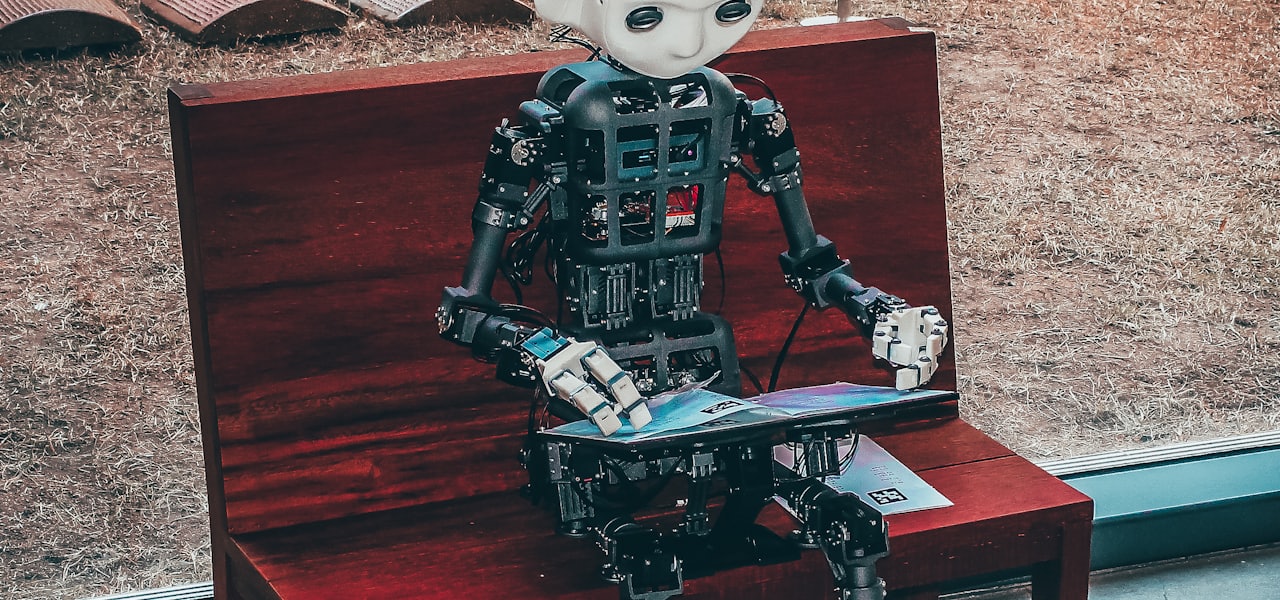
In computer science, a software agent is a computer program that acts for a user or another program in a relationship of agency. The term agent is derived from the Latin agere (to do): an agreement to act on one's behalf. Such "action on behalf of" implies the authority to decide which, if any, action is appropriate. Some agents are colloquially known as bots, from robot. They may be embodied, as when execution is paired with a robot body, or as software such as a chatbot executing on a computer, such as a mobile device, e.g. Siri. Software agents may be autonomous or work together with other agents or people. Software agents interacting with people (e.g. chatbots, human-robot interaction environments) may possess human-like qualities such as natural language understanding and speech, personality or embody humanoid form (see Asimo). Related and derived concepts include intelligent agents (in particular exhibiting some aspects of artificial intelligence, such as reasoning), autonomous agents (capable of modifying the methods of achieving their objectives), distributed agents (being executed on physically distinct computers), multi-agent systems (distributed agents that work together to achieve an objective that could not be accomplished by a single agent acting alone), and mobile agents (agents that can relocate their execution onto different processors). == Concepts == The basic attributes of an autonomous software agent are that agents: are not strictly invoked for a task, but activate themselves, may reside in wait status on a host, perceiving context, may get to run status on a host upon starting conditions, do not require interaction of user, may invoke other tasks including communication. The concept of an agent provides a method of describing a complex software entity that is capable of acting with a certain degree of autonomy in order to accomplish tasks on behalf of its host. But unlike objects, which are defined in terms of methods and attributes, an agent is defined in terms of its behavior. Various authors have proposed different definitions of agents, these commonly include concepts such as: persistence: code is not executed on demand but runs continuously and decides for itself when it should perform some activity; autonomy: agents have capabilities of task selection, prioritization, goal-directed behavior, decision-making without human intervention; social ability: agents are able to engage other components through some sort of communication and coordination, they may collaborate on a task; reactivity: agents perceive the context in which they operate and react to it appropriately. === Distinguishing agents from programs === All agents are programs, but not all programs are agents. Contrasting the term with related concepts may help clarify its meaning. Franklin & Graesser (1997) discuss four key notions that distinguish agents from arbitrary programs: reaction to the environment, autonomy, goal-orientation and persistence. === Intuitive distinguishing agents from objects === Agents are more autonomous than objects. Agents have flexible behavior: reactive, proactive, social. Agents have at least one thread of control but may have more. === Distinguishing agents from expert systems === Expert systems are not coupled to their environment. Expert systems are not designed for reactive, proactive behavior. Expert systems do not consider social ability. === Distinguishing intelligent software agents from intelligent agents in AI === Intelligent agents (also known as rational agents) are not just computer programs: they may also be machines, human beings, communities of human beings (such as firms) or anything that is capable of goal-directed behavior. == Impact of software agents == Software agents may offer various benefits to their end users by automating complex or repetitive tasks. However, there are organizational and cultural impacts of this technology that need to be considered prior to implementing software agents. === Organizational impact === === Work contentment and job satisfaction impact === People like to perform easy tasks providing the sensation of success unless the repetition of the simple tasking is affecting the overall output. In general implementing software agents to perform administrative requirements provides a substantial increase in work contentment, as administering their own work does never please the worker. The effort freed up serves for a higher degree of engagement in the substantial tasks of individual work. Hence, software agents may provide the basics to implement self-controlled work, relieved from hierarchical controls and interference. Such conditions may be secured by application of software agents for required formal support. === Cultural impact === The cultural effects of the implementation of software agents include trust affliction, skills erosion, privacy attrition and social detachment. Some users may not feel entirely comfortable fully delegating important tasks to software applications. Those who start relying solely on intelligent agents may lose important skills, for example, relating to information literacy. In order to act on a user's behalf, a software agent needs to have a complete understanding of a user's profile, including his/her personal preferences. This, in turn, may lead to unpredictable privacy issues. When users start relying on their software agents more, especially for communication activities, they may lose contact with other human users and look at the world with the eyes of their agents. These consequences are what agent researchers and users must consider when dealing with intelligent agent technologies. === History === The concept of an agent can be traced back to Hewitt's Actor Model (Hewitt, 1977) - "A self-contained, interactive and concurrently-executing object, possessing internal state and communication capability." To be more academic, software agent systems are a direct evolution of Multi-Agent Systems (MAS). MAS evolved from Distributed Artificial Intelligence (DAI), Distributed Problem Solving (DPS) and Parallel AI (PAI), thus inheriting all characteristics (good and bad) from DAI and AI. John Sculley's 1987 "Knowledge Navigator" video portrayed an image of a relationship between end-users and agents. Being an ideal first, this field experienced a series of unsuccessful top-down implementations, instead of a piece-by-piece, bottom-up approach. The range of agent types is now (from 1990) broad: WWW, search engines, etc. == Examples of intelligent software agents == === Buyer agents (shopping bots) === Buyer agents travel around a network (e.g. the internet) retrieving information about goods and services. These agents, also known as 'shopping bots', work very efficiently for commodity products such as CDs, books, electronic components, and other one-size-fits-all products. Buyer agents are typically optimized to allow for digital payment services used in e-commerce and traditional businesses. === User agents (personal agents) === User agents, or personal agents, are intelligent agents that take action on your behalf. In this category belong those intelligent agents that already perform, or will shortly perform, the following tasks: Check your e-mail, sort it according to the user's order of preference, and alert you when important emails arrive. Play computer games as your opponent or patrol game areas for you. Assemble customized news reports for you. There are several versions of these, including CNN. Find information for you on the subject of your choice. Fill out forms on the Web automatically for you, storing your information for future reference Scan Web pages looking for and highlighting text that constitutes the "important" part of the information there Discuss topics with you ranging from your deepest fears to sports Facilitate with online job search duties by scanning known job boards and sending the resume to opportunities who meet the desired criteria Profile synchronization across heterogeneous social networks === Monitoring-and-surveillance (predictive) agents === Monitoring and surveillance agents are used to observe and report on equipment, usually computer systems. The agents may keep track of company inventory levels, observe competitors' prices and relay them back to the company, watch stock manipulation by insider trading and rumors, etc. For example, NASA's Jet Propulsion Laboratory has an agent that monitors inventory, planning, schedules equipment orders to keep costs down, and manages food storage facilities. These agents usually monitor complex computer networks that can keep track of the configuration of each computer connected to the network. A special case of monitoring-and-surveillance agents are organizations of agents used to automate decision-making process during tactical operations. The agents monitor the status of assets (ammunition, weapons available, platforms for transport, etc.) and receive goals from hi